
Frequently Asked Questions
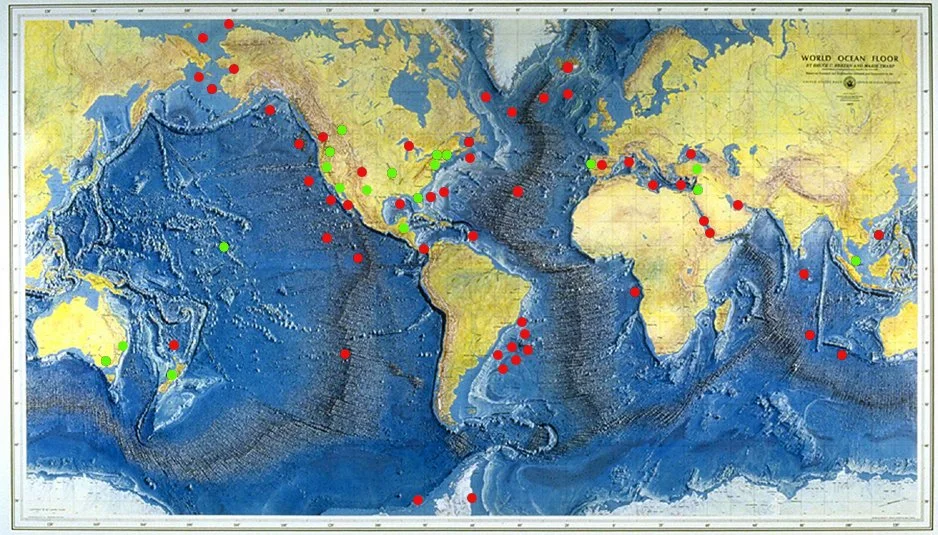
1976 Oceanography Map titled "The Floor of the Oceans" by Marie Tharp & Bruce C. Heezen showing what the floor of the Oceans looked like with the technology of the mid-1970's. Red dots point to sources I used as glazes.
-
I didn’t request them — they came because they were excess, about to be thrown overboard from a ship and someone brought them to me. It’s a fun longer story. Do you want to know how you might get sediments? If there were a simple answer I’d give it to you and if you have time to ‘game that out’, I’ll conjure with you.
-
I stopped making pots in 2016 because my ambitions caused my body to burn out. I don't miss the pain — especially in my hands — but I miss the engagement with people who wanted commissions based on their materials and significant life events. I miss being in the partnered adventures of what will this do when it melts?
-
I always fired in gas kilns, to cone 10 to 11 (about 2,340°F). Some electric kilns can reach that temperature, but vaporized salt from the sediments would corrode their heating elements. If you want to work with electric, the workaround is to enclose your pieces in saggars, which you can make or buy.
Firing months of work at once put me in a hyper-alert state, tuned to the weather and the atmosphere. I was reading smells and sounds, and deciding moment by moment whether to trust my own senses, the digital read-outs, or the pyrometric cones. That kind of intimacy with transformation is hard to describe.
"Temperature means nothing unless time goes with it." — Jim Bailey, kiln builder
-
I suggest testing each sample thin and thick, on concave and convex surfaces, on both light and dark clay bodies, and in different zones of the kiln that run hotter or cooler. If you're reduction firing, try placing samples where the atmosphere is likely to run oxygen-rich versus oxygen-starved.
-
Yes. I keep the ones I know well — the ones with planetary stories that excite me — even though some exist only in small quantities. They feel like a family archive I'm stewarding, in case there's a chance to pass them on to people who'll use them in ways that call for real perseverance. I cast some into garden soil, and gave a few away.
-
I'm collaborative, especially about defining realistic expectations. My mind moves from big picture to practical details, which is useful for thinking ahead. I tend to see possibilities accompanied by task lists. It depends on the project.
-
I'd like to teach, by which I mean enter a partnership with learners who are well-matched to what I know because of my experience. When I had a working studio, I had no time to bring in people who wanted studio and kiln space, but I shared information freely. My dream job would be to concoct something sustainable with an individual, a team, or an organization — to grow something fabulous by pooling our diverse skills toward shared goals. Such endeavors require fair exchanges: if I'm working with people who are being paid for their work, I like to be paid for mine too. And I'm firm on reciprocal effort as well — young people with earning power and durable bodies (neither of which I have in abundance right now) need to work as diligently and committedly as I did, or the results won't likely be greater than the energy that made them. And yes, sometimes enthusiastic energy is reward enough in itself.
-
Only briefly. I did one independent study in ceramics at Goddard College with Phil Homes, the last requirement for my certification to teach in New England public schools. Phil gave me kiln bricks, all the studio time I wanted, and years of friendship and firing advice.
My formal degree is a BFA in painting from Boston University.
-
Great question with a practical answer. I knew I could do only four firings a year and I needed to pay for expenses and some kind of wage for myself from the income. After every firing, I’d spread out the work, write dollar amounts on paper scraps that Im placed into each piece. Some were very desirable, some missed the mark, some were seconds and the occasional miracles needed to pay for the duds. I’d add up the batch and if it seemed close to a minimal fourth of a year’s income, I’d settle there but most often I’d need to add a few thousand. I also worked other jobs to pay for innovation time, for new equipment, and for the work of photographing my pieces and maintaining a web presence.
-
Much as I'd like to be a full-time creative, I still need to work. My income comes from a mix of sources: hosting two rooms in my home on Airbnb, pottery sales, some property oversight, and occasional house cleaning in winter.
-
Yep, I have presentations I've assembled for audiences at places that hosted me: the New England Aquarium, NC State University, Georgetown University, the National Science Foundation, and the STEM Academy on Cape Cod. Each audience was different, and what I've done might be useful for launching a collaborative effort — but it's what can happen with you out in the world from now on that I care most about influencing.
-
I invite you to be in touch in case you have a thought, an idea, a question, or are curious about something I might know about — I'm glad to investigate with you. It's the fun of being alive.
If you have a thought, an idea, want to know something, or are curious about how to amplify something I embody, I'm glad to investigate with you — it's the fun of being alive.